%20scilla.studio.svg)

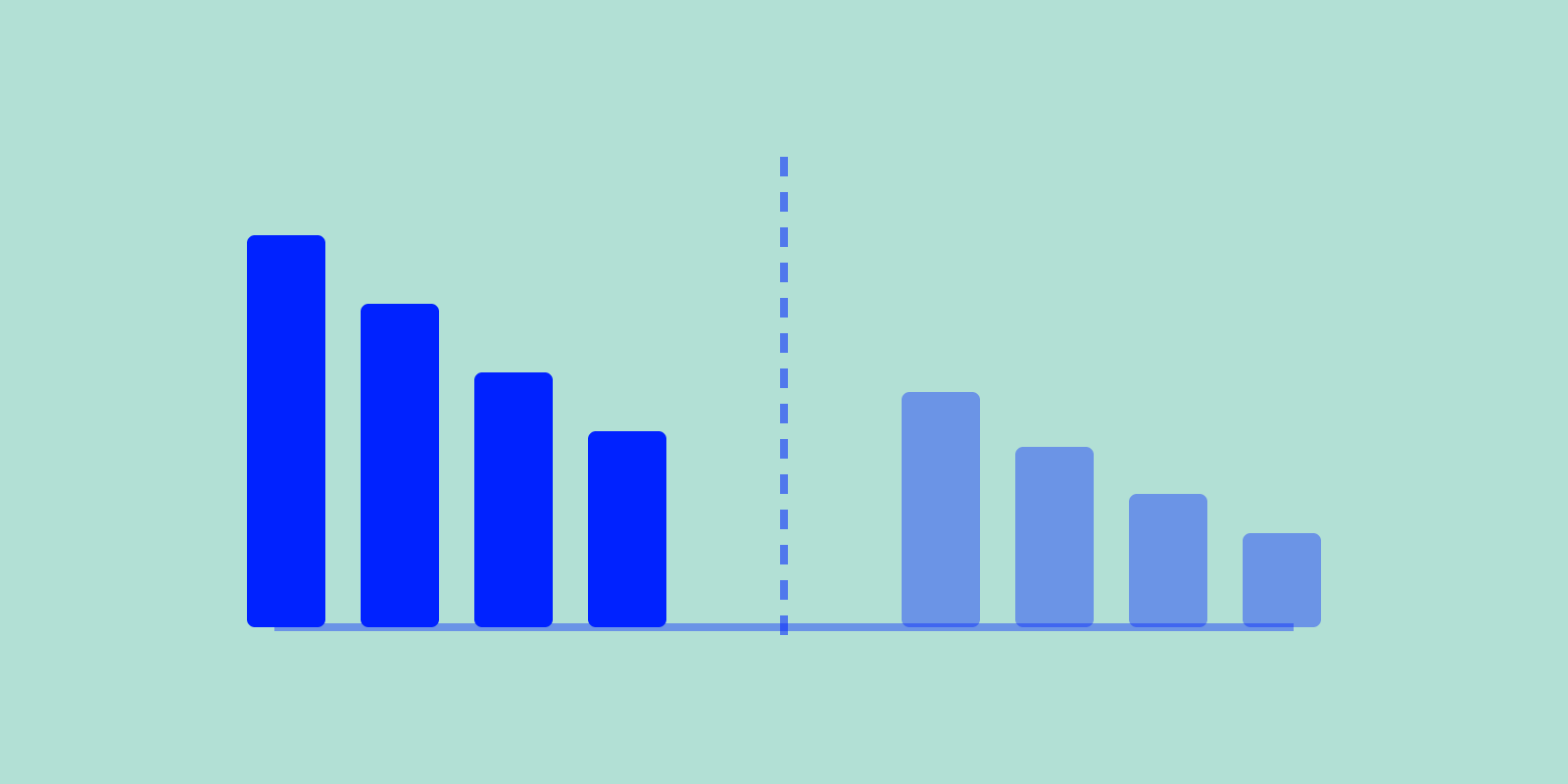
A 12% Day-7 retention rate is a quiet disaster for a B2B SaaS tool and a genuine win for a consumer app. Same number, opposite verdict. The reason is not measurement error or a softer standard for consumer. The two product types run on fundamentally different growth mechanics, and every benchmark inherits that difference. Before you compare your number to anything, you have to know which game you're playing.
This is the most common way founders misread their own data: they grab a "good retention rate" figure from a blog post, never check whether it came from a B2B or consumer dataset, and either panic or relax for the wrong reason. So let's fix that, metric by metric, with the actual ranges side by side and the mechanics that explain the gap.
B2B SaaS and consumer apps follow different growth mechanics, so their benchmarks are not interchangeable. A consumer app acquires huge numbers of low-intent users and loses most of them fast; a B2B tool acquires fewer, higher-intent users who embed it into their work and stay for years. That single structural difference cascades into every metric: retention, virality, unit economics, payback. Comparing your B2B retention to a consumer benchmark (or the reverse) doesn't just mislead you slightly. It points you the wrong way entirely.
Here's the interesting part: this is not a footnote in the benchmark data. It is the organizing principle. The benchmark tool at benchmark.scilla.studio asks you to pick a profile first, B2B SaaS or Consumer, because every band it draws afterward depends on that choice. The number you're chasing literally changes shape.
Retention is where the two profiles diverge the most, so it's the best place to start.
Retention rate = the percentage of a cohort still active a given number of days after they first used the product. Day-7 retention of 50% means half of the people who signed up on day zero came back on day seven.
| Metric | B2B SaaS (avg) | Consumer apps (avg) |
|---|---|---|
| Day-1 retention | 50 to 70% | 20 to 30% |
| Day-7 retention | 40 to 60% | 8 to 15% |
| Day-14 retention | 35 to 55% | 4 to 8% |
| Day-90 retention | 25 to 35% | 1 to 4% |
Sources: Pendo Product Benchmarks, Amplitude, Mixpanel (B2B); Adjust, AppsFlyer, UXCam (consumer).
Look at Day-7. B2B sits at 40 to 60%; consumer at 8 to 15%. That's not a 10% gap: the B2B floor is roughly four times the consumer floor. So which one is "good"? The profile decides it. For a consumer app, Day-7 above 15% is excellent and most apps fall below 10%. For a B2B tool, anything under 40% says the core workflow isn't sticking.
Why the gap? Intent and embedding. Someone who installs a consumer app saw an ad, got curious, and tapped; the cost of leaving is zero and the alternatives are infinite. Someone who adopts a B2B tool usually has a job to do, often inside a team, frequently with their data and their colleagues already inside the product. Leaving is expensive. So the consumer curve drops off steeply and the B2B curve flattens. (And honestly? The "flattening" matters more than any single point: a curve that stops dropping has found its habitual core, regardless of the absolute level.)
A high Day-90 number can still hide a steep, late drop, so watch the shape of the curve and not just the endpoint. Read Why retention drops after Day 1 and the D90 retention deep-dive for how to read the late tail.
Now flip it. On retention, B2B wins. On virality, consumer pulls ahead.
K-factor (viral coefficient) = how many additional users each new user generates through sharing, invitations, and other viral loops before their influence runs out. K = 0.5 means every two users bring one more; K > 1 is self-sustaining viral growth.
| Product type | K-factor (avg) |
|---|---|
| B2B SaaS | 0.1 to 0.3 |
| Consumer apps | 0.3 to 0.7 (rarely >1) |
Sources: Reforge, Andrew Chen.
B2B virality is usually weak: 0.1 to 0.3 is normal, and anything above 0.3 is unusually strong unless the product has built-in collaboration loops (think shared workspaces, documents that pull in colleagues). Consumer products live in social contexts where sharing is native, so 0.3 to 0.7 is the working range, and even 0.5 counts as very strong. K above 1 is extremely rare in either world.
So the same K = 0.35 is "remarkable, dig into what's working" for a B2B tool and "solid but not exceptional" for a consumer app. If you want the mechanics of measuring this loop by loop (including why the naive invites × conversion formula misses most of your real virality) the K-factor explainer goes deep on it.
There's a second lever that the raw coefficient hides: cycle time. A B2B loop where it takes months for one customer to produce the next can have a respectable K on paper and still barely move growth, because the loop turns so slowly. A consumer app where users share daily compounds the same K many times faster. K-factor and cycle time are two different numbers, and the profile shifts both.
LTV:CAC ratio = lifetime value of a customer divided by the cost to acquire them. It tells you whether acquisition pays for itself and by how much.
| Product type | LTV:CAC (avg) |
|---|---|
| B2B SaaS | 3:1 to 5:1 |
| Consumer apps | 2:1 to 4:1 (ideal ≈3:1) |
Sources: Bessemer State of the Cloud, OpenView SaaS Benchmarks, Wall Street Prep (B2B); a16z, AppsFlyer (consumer).
The bands overlap more here, but the shape of "good" still differs. For B2B, ~3:1 is the minimum healthy baseline and above 5:1 often signals you're under-investing in growth (you could spend more to acquire and still profit). Consumer growth is faster but less durable: ratios below 2:1 burn cash, above 4:1 usually means scale is constrained. The same 4.5:1 ratio reads as "you have room to spend more aggressively" for B2B and "near the top of what's realistic" for consumer. (And yes, that means your "great" ratio might actually be a sign you're leaving growth on the table.)
The sharper divide is CAC payback period: how many months of revenue it takes to recoup the cost of acquiring a customer.
| Product type | CAC payback (avg) |
|---|---|
| B2B SaaS | 6 to 12 months (SMB/self-serve), 12 to 24 months (enterprise) |
| Consumer apps | 1 to 6 months |
Sources: OpenView, KeyBanc SaaS Survey (B2B); AppsFlyer, Mobile Dev Memo (consumer).
This is the durability difference made explicit. Consumer products are expected to recoup CAC fast (beyond 6 months usually fails at scale, because consumer retention won't carry a long payback). B2B can tolerate 12, even 24 months for enterprise deals, because the retention is high enough to fund it. The two numbers are linked: B2B's slow payback is only survivable thanks to the same stickiness that makes its retention benchmark four times the consumer one. (See why a long CAC payback isn't automatically a problem and the full CAC payback breakdown.)
What counts as activation? The share of new users who complete the early actions that signal they've reached the product's core value: often onboarding completion, then a first "aha" action.
I'm deliberately not putting a benchmark table here, and that's the point of the section. Activation runs higher for B2B than consumer partly because the user arrived with intent and a task, and partly because B2B onboarding is often guided or even sales-assisted. Consumer activation is lower because much of the top of the funnel is curiosity, not commitment. But the bigger trap here is definitional: "activation" doesn't mean the same event across products. For one product it's "invited a teammate," for another it's "completed a workout," for a third it's "connected a data source." A cross-product activation benchmark would be comparing different events under one label, which is why there's no table above. Define your own activation moment first, then track it over time against your own history, not someone else's number.
The split is one system, not four independent facts. B2B trades fast acquisition for durability: lower virality, slower payback, but retention that flattens high and funds the long payback. Consumer trades durability for speed: stronger virality and fast payback, but retention that collapses, which is why the payback has to be fast. Each profile is internally consistent. Pull one metric out of its profile and compare it to the other and you'll draw exactly the wrong conclusion.
Here's what I actually think: the most useful thing a benchmark can do is tell you which game you're in, then get out of the way. Benchmarks are context, not targets. The job is to understand that your profile makes 50% the right neighborhood, then watch whether your own curve is flattening and your own loops are compounding. Hitting 50% Day-7 because a table said so misses that point.
The free benchmark tool charts your retention curve, K-factor, and unit economics against the B2B SaaS and Consumer bands side by side. Pick your profile, paste your numbers, see in a couple of minutes whether you're inside the band and which metric is dragging. Try it at benchmark.scilla.studio.
For the full profile-specific breakdowns, start with the B2B SaaS growth benchmarks or the Consumer app benchmarks.
What are the main differences between B2B and consumer growth benchmarks? B2B vs consumer growth benchmarks differ across four metrics: retention (B2B Day-7 averages 40 to 60% vs consumer 8 to 15%), K-factor (B2B 0.1 to 0.3 vs consumer 0.3 to 0.7), LTV:CAC (B2B 3:1 to 5:1 vs consumer 2:1 to 4:1), and CAC payback (B2B 6 to 24 months vs consumer 1 to 6 months). B2B trades fast acquisition for durable retention; consumer trades durability for stronger virality and faster payback.
Can I compare my B2B retention to a consumer benchmark? No. B2B and consumer follow different growth mechanics: B2B Day-7 retention averages 40 to 60% while consumer averages 8 to 15%. Comparing across profiles will make a healthy number look broken or a broken one look fine. Always benchmark within your own product type.
Why is consumer retention so much lower than B2B? Intent and embedding. Consumer apps acquire many low-intent, easily-replaceable users, so their curves drop steeply. B2B tools acquire fewer high-intent users who embed the product into their work and team, so their curves flatten higher. The gap is structural, not a quality difference.
Is a higher K-factor always better? Within your profile, generally yes, but cycle time matters as much as the coefficient. A B2B K-factor of 0.3 is strong; a consumer K-factor of 0.3 is just average. And a high K with a slow loop (months between cycles, common in B2B) can grow slower than a lower K that cycles daily.
Why does B2B tolerate a longer CAC payback than consumer? Because B2B retention is high enough to fund it. B2B payback can run 6 to 24 months because those customers stay for years; consumer payback must land in 1 to 6 months because consumer retention won't carry a longer one. The payback benchmark is downstream of the retention benchmark.
Which metric is hardest to benchmark across products? Activation. "Activation" means a different event in every product (invited a teammate, completed a workout, connected a data source) so a cross-product activation benchmark compares different things under one label. Define your own activation moment and track it against your own history rather than an external number.


