Find what will move your growth, in one free hour
Sit down with a senior product operator for one hour. We run your numbers through our growth diagnostic together, and you leave with three next steps, in the order we would take them.
Teams book this hour when growth has stalled
- Growth was fast, then it flattened, and nothing you try gets it going again.
- You run tests, but the results never add up to a direction.
- The board asks what will move revenue, and the team answers with opinions.
- You answer to a business target that the product team can’t move directly.
One hour, on your own numbers
- Bring your numbers. Before the hour, gather these:
- new users or customers per month
- how many are still active after one and three months
- what a customer pays you each month
- what it costs to win a customer
- We fill in the diagnostic with you. Your growth curve takes shape as we go. If a number turns out to be missing, we talk through where it lives and who can get it.
- We agree on three next steps. We read your growth curve with you and name the three moves most likely to lift it.
What you leave with
- Where your growth stands today, set against companies like yours.
- Your growth curve for the next twelve months, and what would change it.
- Three recommendations, in the order we would do them.
Built for product leaders with a live digital product
You hold the product decisions at a company with a digital product or an online store. You might be a CPO, a head of product, or a founder who still owns the roadmap.
After the hour, you choose
Take the three steps home and run them yourselves. We check in a few weeks later to see how it went.
Or set up a project with us. We agree on the outcome you want and how to get there, and we bring in the operator who runs it.
Try the diagnostic on your own first?
Fill in the growth diagnostic yourself. It takes about six minutes. Whenever you need someone to bounce your interpretations off, schedule the free session and get our eyes on your numbers.
Andreas Quensel describes how Heja runs its growth model in our podcast episode with him.
Book your free hour
Bring your growth numbers. You leave with three next steps, in order.
Book the free hour →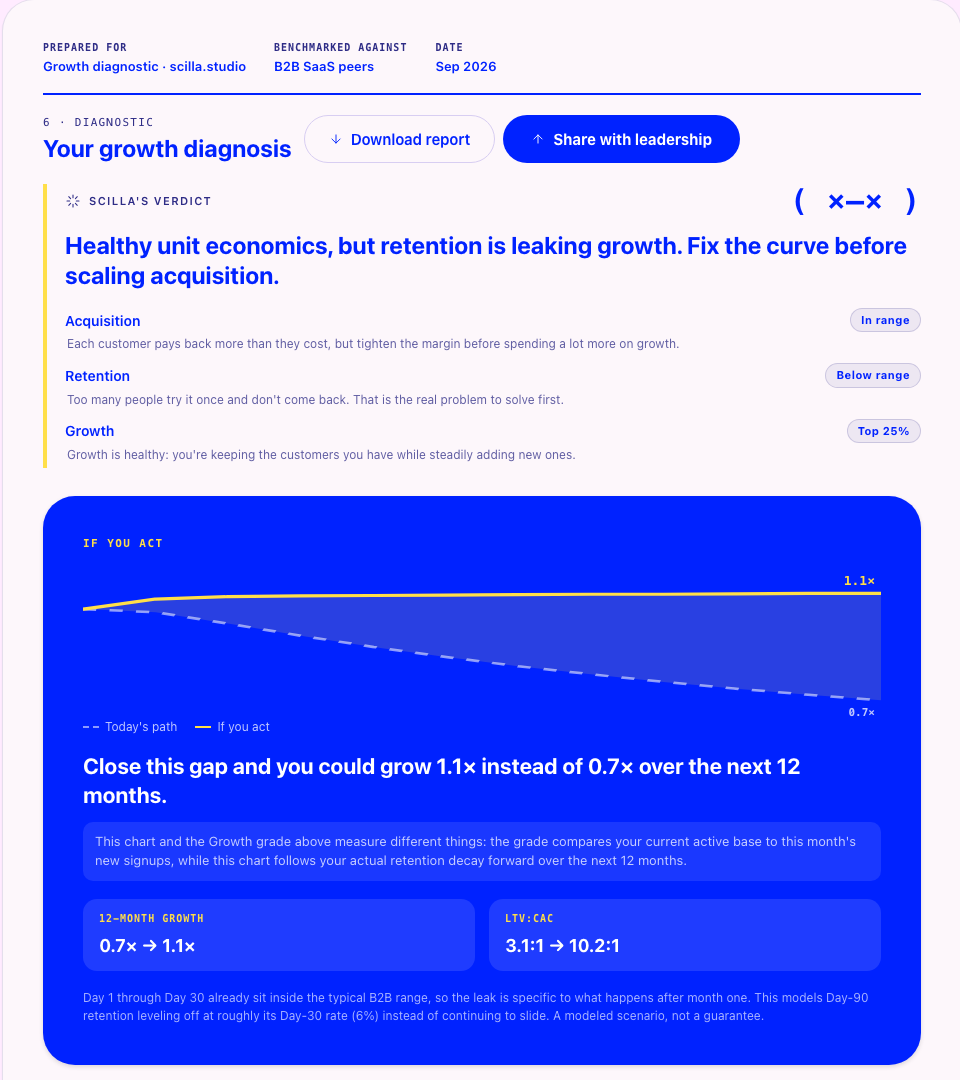 Sample report
 More client proof
- Bambuser A growth team built the growth model and a self-serve path beside enterprise sales; lead conversion rose 260 percent in four months. Read the case →
- Plick The loop model and hypothesis backlog it produced: 48 experiments in six months, revenue up 13 percent. Read the case →
- Lassie A step-two drop traced to the price landing too late; the rebuilt flow showed it at every choice point. Read the case →
- Cetti From Excel pivot tables to self-serve Mixpanel: 14 named events and dashboards the team runs on its own. Read the case →
- Hapkey A walkthrough surfaced a broken activation loop and a dashboard that stayed empty after sign-up. Read the case →
- Teemyco New users never grasped the point, so onboarding was reworked to show value before asking for anything. Read the case →
- ScreenSmart The core exchange was described but never shown before sign-up; the fix ranked top, with no rebuild needed. Read the case →
- Skymaker The config step assumed knowledge first-time users lack, so self-service quietly leaned on a salesperson. Read the case →
- Chroma The workshop replaced 'whoever argued hardest' with a loop map the whole team drew themselves. Read the case →
- Fishbrain Loop sketches tied to real user behaviour gave the team a shared language for judging growth bets. Read the case →
- Briox The workshop turned the marketplace's three assumptions into measurable questions to test in live usage. Read the case →
- Fortnox A cross-team naming standard and dashboards gave 20-plus autonomous teams one shared read of the product. Read the case →
- TeledyneFLIR An iOS-only pilot proved the way of working, then grew into KPI work across roughly 20 product managers. Read the case →
- Strawberry A cost-per-booking dashboard built to answer hotel managers' questions in their own terms. Read the case →
- Kognic Seven engineering teams had the tool but no process; a workshop left each with a template and a named next step. Read the case →
- Apotek Hjärtat A hypothesis register carries each quarterly cycle's learnings into the next one. Read the case →
- H&M Eleven teams trained on experiment culture, grounded in a 1,400-experiment track record and its 31 percent win rate. Read the case →